
Most people who sit in a classic Defender for the first time have the same reaction after ten minutes in traffic. They love the car. They’re less sure about the clutch.
It’s a heavy pedal, the gearbox wants a deliberate hand, and in a city that stops every hundred metres it gets tiring fast. So one of the questions we hear most when a client is speccing a custom build is whether the car can be automatic. It can. Whether it should be is a better question, and that’s what this post is about.
Did Land Rover ever make an automatic Defender?
Barely. Almost every classic Defender left the factory with a manual gearbox. The exception most people point to is the North American Defender 90 of 1997, which could be ordered with the V8 and a ZF four speed automatic. The Range Rover Classic is a different story. Land Rover paired the same V8 with ZF automatics in it for years.
That matters, because it means an automatic Defender isn’t some strange experiment. The gearbox and engine combination is one Land Rover itself used and refined. A conversion mostly borrows that work.
The gearboxes people actually use
You’ll see two names come up again and again: the ZF 4HP22 and the 4HP24.
The 4HP22 is the original. Four speeds, a proven unit, and plenty for a road going V8 Defender driven the way most owners drive. The 4HP24 is the later, stronger version that came in the bigger V8 Range Rovers. If the engine has been built up for more torque, or the car is going to tow or work hard, that’s usually where we’d lean.
There’s a third route too. On a full LS3 V8 build, the engine normally comes with a modern six speed automatic, which is a different project altogether. We cover that side in our Defender restomod post.
What the conversion really involves
Swapping the gearbox is the easy part to describe and the part people underestimate. A proper Land Rover Defender automatic transmission conversion touches a lot of the car:
- The gearbox has to mate cleanly to the engine and to the Defender’s transfer box, with the right adaptor parts and mounts.
- Propshafts usually need to be changed to suit the new lengths.
- An automatic makes heat, so it needs its own oil cooler and lines, routed where they won’t get damaged off road.
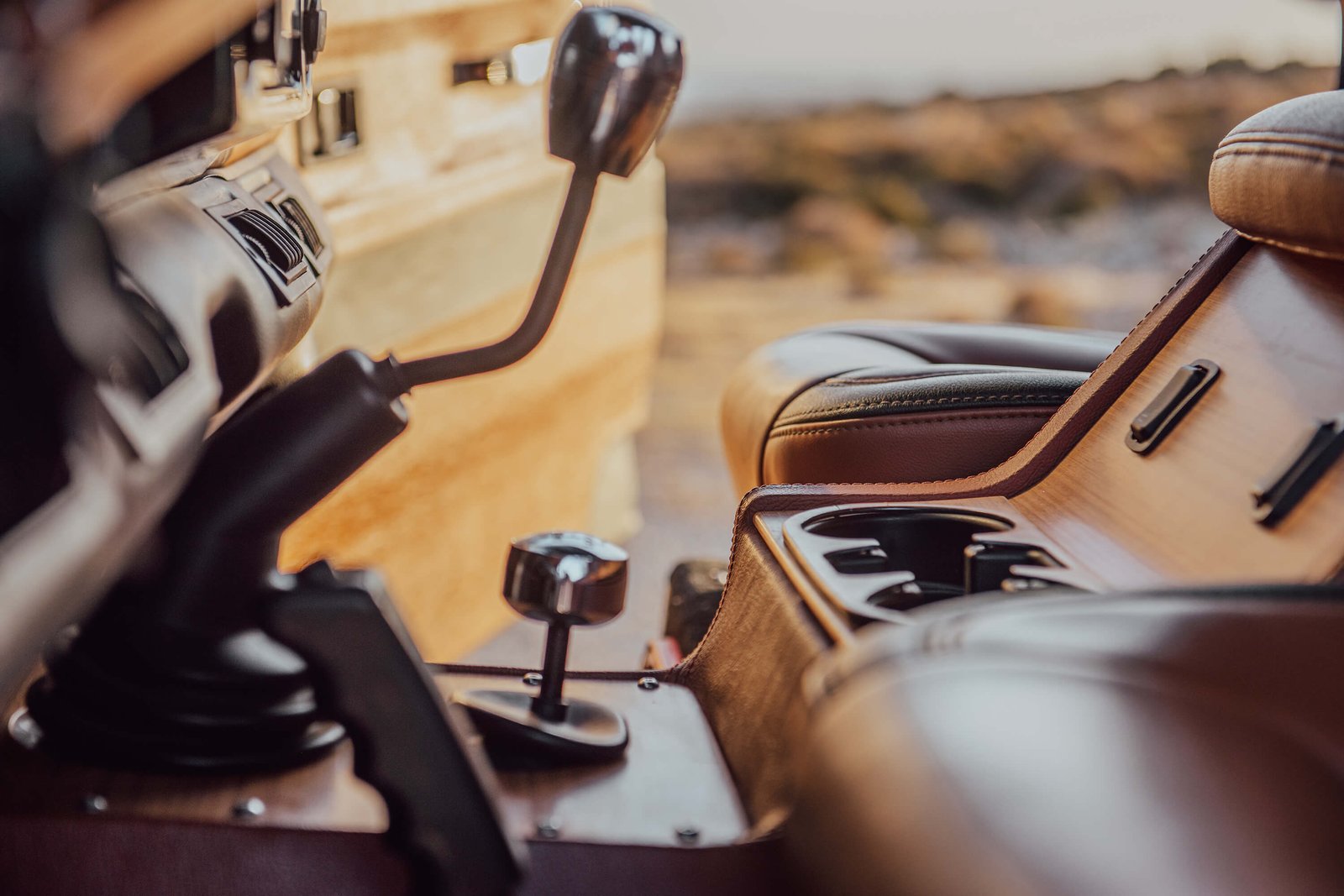
- The selector, the wiring and the starter inhibitor all have to be installed so the car can only start in Park or Neutral.
- The floor and tunnel area usually needs work so the selector sits where your hand naturally falls.
Done well, none of this is visible when you get in. Done badly, it’s the kind of thing you notice every single drive: a selector at an odd angle, a cooler line rubbing on something, a car that won’t start because one connection is wrong.
What you gain, and what you give up
The gain is obvious the first morning. No clutch, a lot less effort in traffic, and a car your partner might actually agree to drive. With a V8 in particular, an automatic suits the engine’s character. It’s relaxed, it pulls smoothly, and it makes the whole car feel calmer.
The honest list of downsides is short but real. Fuel use goes up a bit. You lose some of the engine braking you’d get from a manual on a steep descent, although low range helps a lot. And an older four speed automatic will never feel like a modern car on the motorway. If you love the mechanical feel of shifting a Defender yourself, keep the manual. Plenty of owners do, and honestly, we get it.
Decide at the start, not halfway through
If there’s one thing we’d tell anyone thinking about this, it’s to decide early. On a custom build, the gearbox choice ties into the engine choice, the floor, the wiring and the cooling. Making that call at the spec stage, while the car is in pieces anyway, is far cleaner than changing your mind once it’s painted and trimmed.
That’s why the gearbox conversation sits right next to the engine conversation when we plan a build with a client. If you haven’t read it yet, our guide to choosing the right Defender engine is a good companion to this post.
So, should yours be automatic?
If the car is going to live in a city, be driven most weeks, or be shared with someone who doesn’t want a clutch, an automatic is usually the right answer. If it’s a weekend car you want to feel every gear change in, keep the manual. Neither is wrong.
You can see some of the Defenders we’ve built on our restored Defender page. And if you’re starting to put a spec together, get in touch. We’ll talk it through with you before anything gets ordered.