
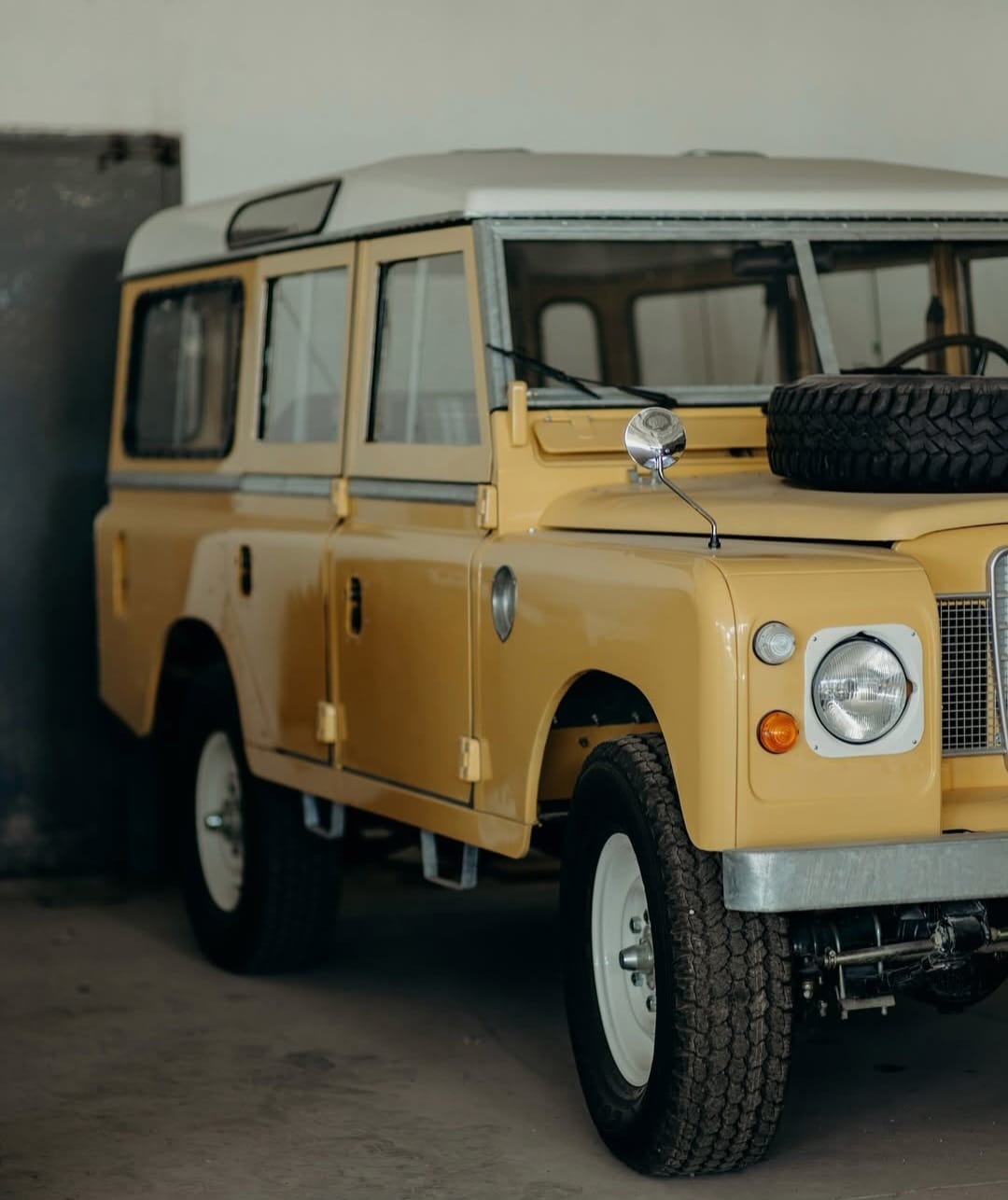
The Land Rover was never supposed to be an icon. It was supposed to be a stopgap. That’s the part of the story I keep coming back to, because almost everything people love about these cars comes from the fact that nobody was designing them to be loved.
A farm vehicle built from what was lying around
Rover came out of the Second World War short on steel and short on demand for its saloon cars. Chief designer Maurice Wilks had been using a war-surplus Willys Jeep on his farm in Wales, and the idea was simple: build something similar, British, and useful on a farm. Early bodies were aluminium because that was what the factory could get hold of. The Series I was shown at the Amsterdam Motor Show in 1948, and it sold far better than the company expected.
Part of the reason is that it did more than drive. A power take-off could run a saw, a pump or a baler, so the same vehicle that carried the farmer to the field also worked in it. Then the militaries, the missionaries, the survey teams and the expedition crews found out about it, and the Land Rover ended up in places most cars never reached.
Series I, II and III
The Series I of 1948 gave way to the Series II in 1958, with a wider body and the curved side panels that many people still think of as the classic Land Rover shape. The Series III followed in 1971 with mostly practical updates, including a redesigned dashboard and a synchromesh gearbox. Underneath, the formula barely moved: a ladder chassis, leaf springs, a simple body you could repair with basic tools.
That simplicity is the reason so many Series cars survive today, and the reason they restore so well. Nothing is hidden, and everything can be rebuilt.
The One Ten, the Ninety and the name Defender
In 1983 Land Rover introduced the One Ten, followed by the Ninety in 1984. Both moved to coil springs, which made them noticeably more comfortable, and both kept the same basic idea. The name Defender only arrived in 1990, when Land Rover needed to separate these models from the new Discovery. So for a while there were Land Rovers that were not yet called Defenders, which surprises a lot of people.
The Defender stayed in production, with regular updates, until the last one left the Solihull line in January 2016. That’s close to seven decades from the first Series I, with the shape still recognisable.
Why it became an icon anyway
I think it comes down to honesty. A Series or an early Defender does what it looks like it does. The flat panels, the exposed hinges, the upright seating position all exist because someone needed them to. Nothing on the car is there for show, and people can feel that, even if they couldn’t explain it.
It also helps that these vehicles were used, properly, by ordinary people for decades. Farmers, park rangers, doctors on rural rounds. The cultural weight came from the work, not from a marketing department.
What this means if you’re thinking about owning one
Age is the main thing to understand. A car from the 1950s or the 1990s has had a long life, and the condition of the chassis and body decides everything that follows. That’s why we spend so much of our effort there, and why we keep our focus on models up to the year 2000, the era where the original character is strongest.
If the Series side appeals to you, our restored Series builds are worth a look, and we wrote about why Series cars still command the prices they do. If you’d rather talk it through, get in touch and tell us what you have in mind.