
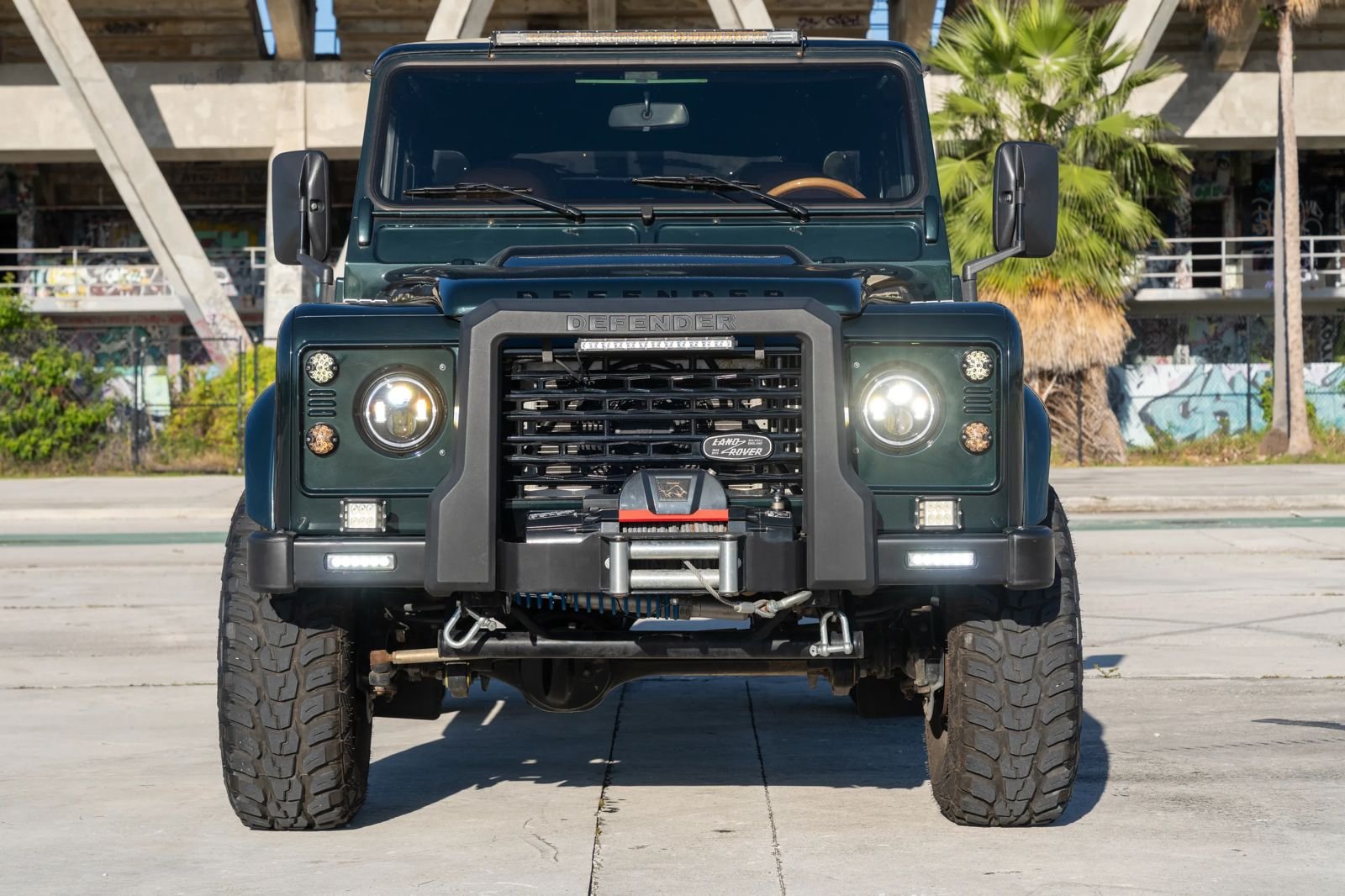
Here’s a comparison we keep coming back to. In August 2026 the average new vehicle in America sold for a little over $50,000, according to Kelley Blue Book. The same week we were writing this, a 1994 Defender 90 sold on Bring a Trailer for $57,500. A thirty year old V8 truck with no touchscreen, priced like a brand new family SUV.
That isn’t a fluke, and it isn’t only about nostalgia. Two things are pushing in the same direction: new petrol cars are getting harder to come by in a lot of markets, and the ones that remain look more and more alike. A vintage Land Rover Defender gets the benefit of both.
What the auction results actually show
Anyone can check this, which is why we like it. Bring a Trailer’s Defender results page lists more than 2,500 finished auctions, and the recent ones tell a pretty consistent story. Between late September and early October 2026, a 1993 Defender 110 sold for $62,500, a 1996 110 pickup for $69,000 and a 1998 Defender 130 for $75,000.
Now look at the other end of the page. An 18,000 mile 2020 Defender 110, the new generation, with a six cylinder petrol engine and every modern comfort, saw bidding stop at $36,750 in late September and didn’t sell. To those bidders, a six year old example of the newest model was worth less than a 1994 truck five times its age.
A fair caveat: auction prices swing with condition, history and who happens to be bidding that week, and plenty of older Defenders sell for less. The point is that the good ones now trade at or above the price of an ordinary new car, and they get there without the depreciation a new car takes the day it leaves the lot.
New petrol cars are getting scarcer
The UK and the European Union have both set dates to end sales of new petrol and diesel cars, and those dates keep getting revised as governments and carmakers argue over the details. Whatever the final timeline looks like, the direction is clear. Every year there are fewer new combustion models on sale, and more of the ones that remain are hybrids, downsized turbo engines or something built mainly to hit an emissions number.
To be clear, none of this bans classics. The rules are about selling new cars, and a 1990s Defender you already own or buy secondhand isn’t affected. What changes is the market around it. When the showroom stops offering a simple, mechanical, petrol or diesel truck, the only place left to get one is the existing supply. And the existing supply of classic Defenders stopped growing in January 2016, when the last one came off the line. (We covered that history in our story of the classic Land Rover.)
Uniqueness counts for more when everything looks the same
Walk through any parking lot and count how many crossovers you could tell apart with the badges taped over. Not many. Modern cars are safer and more efficient than ever, and also more alike than ever, because they’re all designed around the same regulations and the same big screens.
A vintage Land Rover Defender is the opposite. You can see how it’s put together. You can fix most of it with ordinary tools. It looks like nothing else on the road, and the people who want one usually want it badly. As the new car market keeps converging, that difference gets more valuable, not less. Scarcity sets the floor under these prices. Character is what keeps people bidding above it.
What this does and doesn’t mean
We’ll be straight, the same way we were in our piece on what a classic Defender is worth. Nobody can promise a car will go up in value, and we won’t. What we can say is that values have risen, and the reasons behind it are getting stronger rather than weaker.
It also matters a lot which Defender you’re talking about. The trend lifts good trucks far more than tired ones. A Defender with a sound chassis, a properly rebuilt drivetrain and a documented history is the kind that brings $60,000 and up at auction. At the other end, a 1991 Defender 110 V8 pickup was bid to just $10,000 in early October and didn’t sell. Condition and history explain most of a gap like that. If you want the full picture of how condition drives price, our guide to restoration costs walks through it.
For US buyers there’s one more filter: the truck has to be at least 25 years old and imported properly, which is why the Defenders we build for the US are model year 2000 and earlier. Our US import guide covers why a clean paper trail matters when you sell later.
Buying into it
If the case above makes sense to you, the practical question is which truck. Our restored Defenders are built with the structural and mechanical work done and photographed at every stage, so you know what you’re buying. Or tell us what you’re after and we’ll give you an honest view of where a particular truck sits in today’s market.